Choose a startup community around the decision or connection you need next. Look for relevant people, useful exchanges and clear participation rules, then test the fit before making a bigger commitment. A large member count or an investor logo does not tell you whether the community will help with your particular goal.
01. Decide what the community should help you do.
A startup community is a group of people connected by building or supporting startups. That can mean a local event series, an online discussion group, a peer circle or a professional network. The label alone tells you little about the experience. Before comparing options, finish this sentence: “Over the next month, I need help with ___, from people who have experience with ___.”
Keep the answer narrow enough to test. “Grow my network” is hard to evaluate. “Talk to founders who have recently sold to the same kind of customer” gives you a clear reason to participate. If you are preparing for fundraising, you might instead need feedback on your investor-fit criteria before asking anyone for an introduction. These are different jobs, and they may lead you to different rooms.
Write down your constraints beside that goal: the time you can spend, the time zones you can join, what you can pay and the information you are comfortable sharing. Treat those constraints as part of fit. A well-run community can still be the wrong choice if its activities take place while you are asleep or require a commitment you cannot maintain.
- For investor connections: seek people with relevant fundraising experience and check how introductions actually happen.
- For co-founder search: look for a way to learn about someone’s commitment and work together before making a decision.
- For operating advice: seek peers who have faced the specific customer, hiring or product problem you are working through.
02. Match the format to the conversation you need.
Different formats support different kinds of participation. An open discussion space lets you observe how people answer questions. A recurring peer group can give you continuity. An event creates a bounded opportunity to meet people. A matching service focuses on a particular connection. Start with the kind of exchange you need, then check whether the format makes that exchange possible.
For example, Techstars describes Startup Weekend as a three-day event where aspiring founders pitch ideas and assemble teams. YC’s Co-Founder Matching service is specifically designed for people seeking a co-founder. Those are different starting points: a concentrated building event and a service focused on finding a potential partner. Neither description proves that a specific person will be available or that a connection will work out.
Ask what happens after you join or attend. Can participants keep a conversation going? Is there a clear way to ask for help? Does access depend on approval, a ticket or membership? Verify those details with the organizer. Avoid treating every startup-branded offering as an interchangeable source of investors, customers and co-founders.
Sources: Techstars: Startup Weekend ↗ Y Combinator: Co-Founder Matching ↗
Your network is part
of what you’re building.
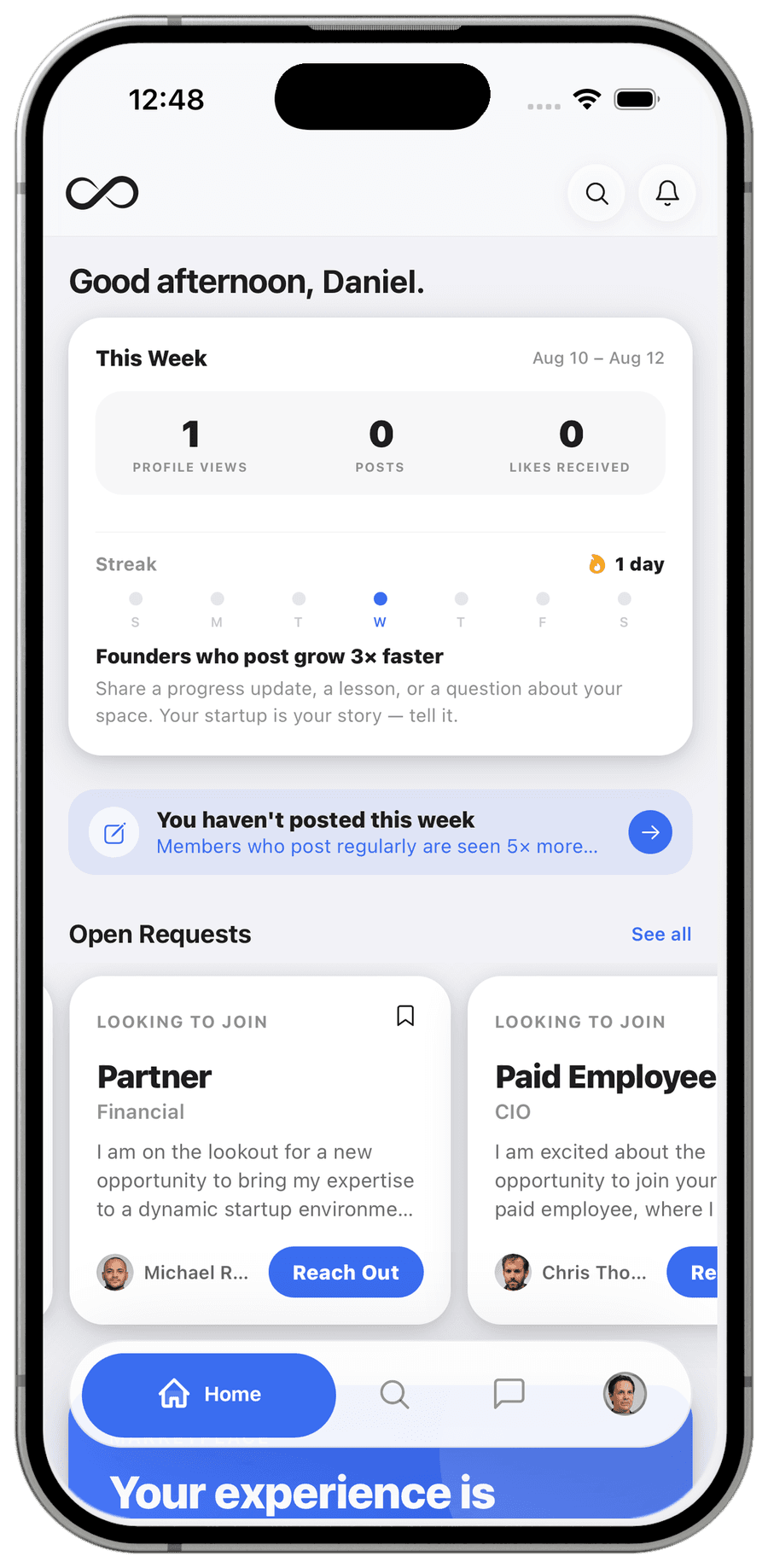
Solution is a social network for founders, investors, mentors and the wider startup ecosystem. Explore the app to see whether it fits your next step.
03. Look for evidence of useful participation.
Before committing, inspect whatever you can legitimately access: a public discussion, an event agenda, participation guidelines or a sample session. If the group is private, ask the organizer how members usually participate and whether a preview is available. You do not need access to private conversations to ask how the community is run.
Look for specificity. A discussion about a concrete problem, with replies that explain their reasoning, gives you something to evaluate. A feed full of announcements gives you a different kind of evidence. Neither a famous member nor a large audience tells you how often members respond, which topics receive help or whether newcomers can participate.
Keep observations separate from assumptions. “The last public session covered customer interviews” is an observation. “Members will introduce me to buyers” is an assumption until you understand the process and have permission from the people involved. Record unknowns rather than assigning them an optimistic answer.
- Check whether the conversations match your stage, business model and immediate challenge.
- Read the expectations for promotion, unsolicited messages, confidentiality and moderation.
- Ask whether any advertised investor participation is current and what access actually includes.
- Understand the full cost and cancellation terms before paying; do not infer value from price alone.
04. Make it easy for someone to understand your request.
Once you join, introduce yourself through the problem you are working on, not a long company pitch. Explain the relevant context, what you have already tried and the question you want help with. Give people enough information to decide whether their experience is useful. Keep private customer or company details out of a public post.
In his guidance on emailing early-stage investors, Michael Seibel recommends explaining your company clearly and being explicit about how the recipient can help. Our adaptation for a community introduction is below. It is an illustrative template, not a message that has been tested to produce a particular response rate.
If the next step is an introduction, let the potential connector decide whether they know the person well enough to help. Ask them to check interest before sharing contact details or adding anyone to a conversation. A community gives you a place to begin a relationship; it does not create an obligation for other members.
Hi everyone — I’m building [specific product] for [specific customer].

Right now I’m deciding [one concrete question]. We’ve tried [brief, factual context], and I’d value a perspective from someone who has handled [relevant situation].

Would anyone be open to sharing how they approached it, here or in a short conversation? I can also help with [something specific you can contribute].
Sources: Michael Seibel: How to Email Early Stage Investors ↗
05. Run a small trial, then review what happened.
Use a short trial to replace impressions with observations. Two weeks is an editorial suggestion for organizing your attention, not a proven period for measuring community value. For a group that meets monthly, a longer review period may make more sense. Choose a window that lets you participate in the actual format without turning networking into your full-time job.
At the start, write down one useful outcome: feedback that changes a decision, a conversation with a relevant peer or a clearer understanding of a problem. Participate in a way that suits the community’s rules. Ask one focused question, answer something you can help with and attend a relevant session if one is available. A connection may need time; the trial is a check on fit, not a deadline for someone else to deliver value.
At the end, review what you learned and the effort it took. Did you find relevant people? Were you able to participate? What remains unknown? If the group was quiet during your window, distinguish “not enough evidence yet” from “a poor community.” You can extend the test, change how you participate or decide that another format better serves your current needs.
- Before: record your goal, time budget and what would count as a useful exchange.
- During: keep brief notes on what you asked, what you contributed and what changed in your understanding.
- After: compare the evidence with your goal and decide whether to continue, adjust or leave.
06. Decide whether Solution fits your next step.
Solution is a social network for the startup ecosystem, bringing founders, investors, mentors and other startup professionals into one product. If your goal is to discover people in that ecosystem, you can explore the app and evaluate whether the people and conversations you find match your needs. Use the same evidence standards you would apply to any other community.
Solution publishes this guide, so we have an interest in you considering the app. That is why the worksheet below focuses on observations you can make yourself. It does not rank Solution above other options, predict fundraising success or suggest that downloading the app guarantees an introduction.
Start with a specific reason to connect and a profile that explains what you are building. Then choose your next conversation thoughtfully. The App Store and Google Play links in this guide take you to Solution’s listings, where you can review the current app information before downloading.
Sources: Solution: The Hub For Startups ↗
Test a community against your needs.
Score only what you have observed: 0 = no evidence, 1 = mixed evidence, 2 = clear evidence. These are editorial prompts, not a validated predictor of results. Your answers stay on this page and reset when you reload.
Answer all five prompts to see your evidence total.
Questions founders ask
What is the best startup community for a first-time founder?
Choose based on the help you need now, your ability to participate and evidence that relevant people are active. There is no single best community for every founder. Use the scorecard to record observations, then test whether participation helps with a specific decision.
Should I join a community just to meet investors?
Check what investor participation actually means before joining. Attendance, a directory entry and permission to request an introduction are different things. Start with investor fit and useful relationships; membership by itself does not guarantee access or investment.
Is a paid founder community better than a free one?
Price alone does not establish fit. Compare the actual format, participation requirements, relevant experience, cost and cancellation terms. If evidence is limited, ask for a sample session or a clear explanation of what membership includes before deciding.
How many startup communities should I join?
Start with as many as you can participate in thoughtfully within your time budget. For a focused trial, choosing one primary community makes it easier to connect your effort with what you learn. Add another only when it serves a different, specific need.
Written by Solution editorial. Platform descriptions were checked against the sources below. The worksheet and examples are our editorial framework, not research findings or promises of results. Solution publishes this guide and offers its own startup networking app.
- Techstars: Startup Weekend ↗ · Checked 2026-10-22
- Y Combinator: Co-Founder Matching ↗ · Checked 2026-10-22
- Michael Seibel: How to Email Early Stage Investors ↗ · Checked 2026-10-22
- Solution: The Hub For Startups ↗ · Checked 2026-10-22
Found an error? Tell us so we can correct it.
Put the guide into practice.
Start a new connection.
Find Solution on the App Store and Google Play.