Start with the decision you need help making, then look for someone with relevant experience and a realistic way to connect. Explain your situation, what you have already tried and the question you want to explore. Begin with a bounded conversation and agree separately whether ongoing mentorship makes sense. A mentor can improve your thinking; responsibility for the decision stays with you.
01. Describe the decision, not just the wish for a mentor.
“I need a startup mentor” describes a relationship you want, but leaves the work undefined. You might need help choosing an initial customer, organizing a sales process or deciding which role to hire. Write the decision in ordinary language before you search. This helps another person recognize whether their experience is relevant.
For example: “I have an early product for independent retailers and need to decide whether to sell directly or work through an industry partner.” Add what you know, what remains uncertain and the constraints you cannot ignore. You are preparing a conversation, not a pitch designed to make every detail sound settled.
Our editorial view is that useful fit matters more than a recognizable name. A person with relevant experience can still lack the time or context to help. Treat a public biography as a reason to investigate a connection, not proof that the person will mentor you or that their previous approach will transfer unchanged.
02. Search through people and places connected to the work.
The University of Cincinnati’s guidance points founders toward their existing network, professional groups, events and startup support environments. These are starting points for discovery, not a promise of access. Ask yourself where people with the relevant operating experience participate, rather than joining every group with “startup” in its name.
Look at the person’s actual work and current focus. Someone who led enterprise sales may have useful questions about selling, but the context could differ from an early founder selling a small subscription. Read enough to explain why you are asking this person. If their experience or availability is unclear, leave it as an open question.
If you use a structured program, check its current eligibility and process. Techstars describes mentoring as work shaped by program needs and a mentor’s availability; its mentor application is not an on-demand booking promise for any founder. A directory entry or program page should not become an assumption that a particular person is available to you.
Sources: University of Cincinnati: How to find startup mentors ↗ Techstars: Mentor FAQs ↗
Your network is part
of what you’re building.
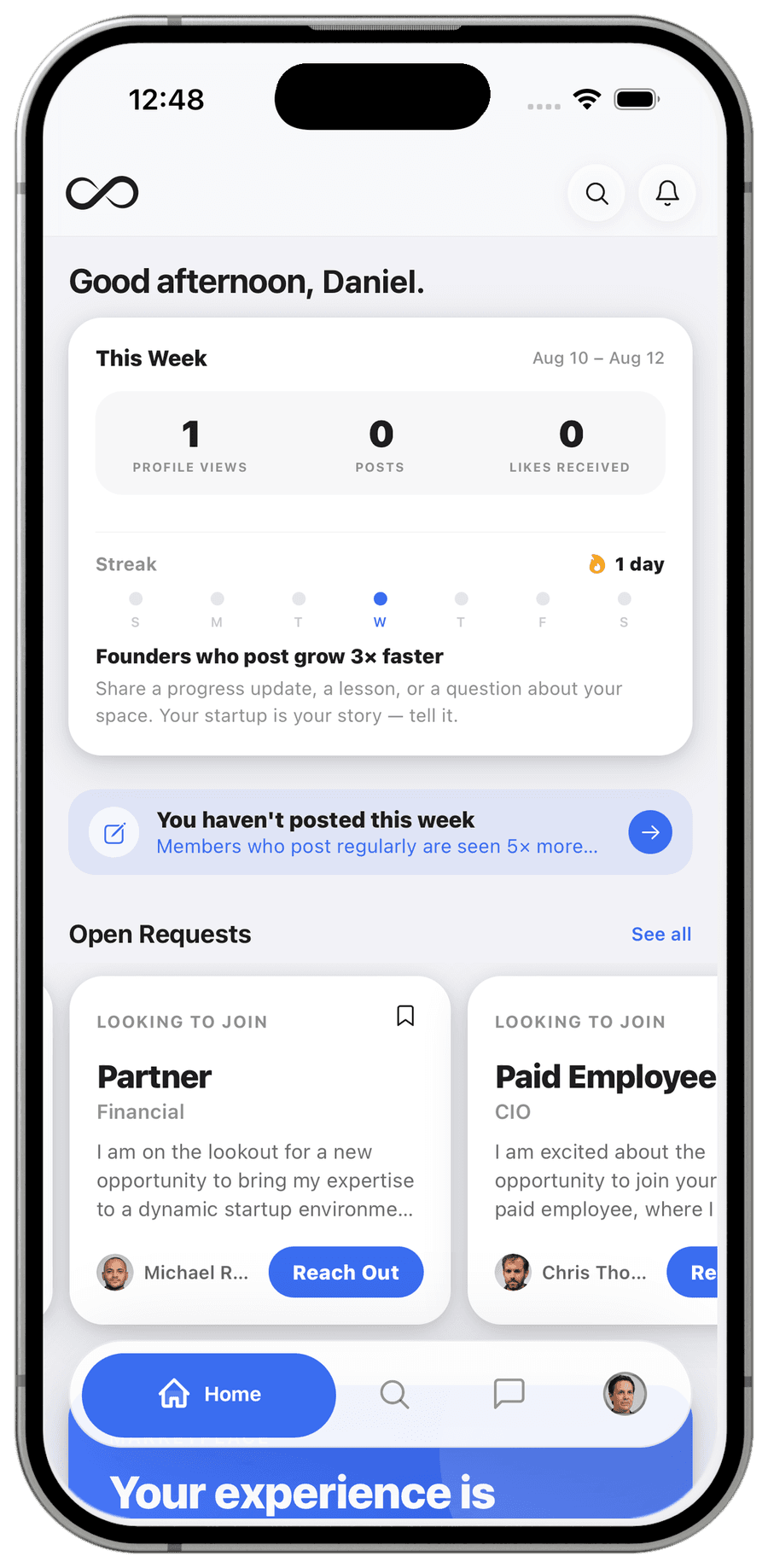
Solution is a social network for founders, investors, mentors and the wider startup ecosystem. Explore the app to see whether it fits your next step.
03. Ask for a conversation the person can understand.
Explain what you are building, why their experience caught your attention and what you would like to discuss. Say what you have already tried so they can understand the gap. Keep the scope honest: asking someone to consider a specific question is different from assuming they have accepted an ongoing advisory role.
Use the preparation card below to shape your own message. It is an editorial planning aid, not a tested outreach formula. If a community or program has a required introduction format, use that format. Respect a decline or the absence of a reply; neither creates a reason to pursue the person through unrelated private channels.
MENTOR CONVERSATION PREPARATION

My current decision: [specific choice].
Relevant context: [stage, customer and constraints].
What I have tried: [actual work or evidence].
Why this person: [verified experience relevant to the decision].
What I would like to explore: [one useful question].
Material I can share: [brief, appropriate context].
Scope I am requesting: [a conversation they can accept, adjust or decline].
What is not assumed: ongoing time, introductions or a formal advisory role.
Replace the placeholders with accurate details before sending.
04. Explore the reasoning behind the advice.
Techstars’ Mentor Manifesto calls for distinguishing opinion from fact and guiding founders without taking over their decisions. Apply that distinction to your own notes. When someone suggests a direction, ask what experience informs it and which assumptions would need to hold in your situation.
Useful questions might be: “What was different about the customer when you tried that?” or “What would you want to learn before choosing this route?” You are looking for reasoning you can examine, not an instruction that removes uncertainty. If an answer is outside the person’s experience, an honest limit is more useful than confidence without a basis.
Before the conversation ends, summarize the part you understood and the next investigation you intend to make. Give the mentor an opportunity to correct your interpretation. Keep any confidential material within the boundaries you agreed. Do not treat a private discussion as permission to quote an endorsement or share the person’s contact details.
Sources: Techstars: The Mentor Manifesto ↗
05. Test whether the advice fits your actual situation.
Consider an illustrative founder, Leila, who is choosing between selling directly to retailers and pursuing a distribution partner. A potential mentor previously built a partner channel for an established supplier. Leila arrives with the customer profile, her current offer and the questions she has not resolved. This is a fictional teaching example, not a Solution customer result.
The mentor suggests a partner route. Instead of treating that as a verdict, Leila asks what made it work in the earlier business. She learns that the supplier already had support capacity and a product that partners could demonstrate. Those conditions are not yet established in her company.
Leila leaves with a more specific investigation: what would a plausible partner need before discussing a trial? She can explore that question without claiming the mentor has validated the business or promised an introduction. The conversation was useful because it made the missing conditions visible, even though it did not select the route for her.
06. Decide together whether to continue.
After trying an appropriate next step, send a concise update if the person welcomes one. Explain what you learned and what remains open. If another conversation would be useful, ask rather than assuming a recurring place in their calendar. A good first discussion does not automatically establish a long-term commitment.
If both sides want ongoing mentorship, discuss what kinds of questions belong in the relationship, how you will arrange contact and what each person can realistically offer. Clarify any proposed commercial or formal advisory arrangement separately; do not assume the word mentor settles terms or expectations.
Review usefulness through what you can now understand or investigate more clearly. A mentor cannot supply every kind of expertise, guarantee fundraising or make a difficult decision certain. You may need another perspective for a different problem, or decide that a peer conversation serves your current need better.
07. Make your reason to connect easy to recognize.
Solution is a social network for the startup ecosystem, including founders, mentors and operators. If you are exploring people in that ecosystem, describe what you are working on and the experience you hope to learn from. The app is a place to explore relevance, not proof that any particular member has agreed to mentor you.
Use the same question wherever you meet someone: does their experience help you think about this decision, and is there mutual interest in a conversation? Start there, then let the scope of the relationship be something you agree together.
Sources: Solution: The Hub For Startups ↗
Questions founders ask
Where can I find a startup mentor?
Begin with relevant people in your existing network, professional groups and startup support environments. Check the actual program or community process and look for experience that matches your current question. Membership or a public profile does not establish availability.
Do I need a famous founder as my mentor?
A recognizable name does not establish fit for your decision. Look for relevant experience, a willingness to discuss its limits and a practical opportunity to connect. The guidance still needs to be evaluated against your own situation.
What should I bring to the first mentor conversation?
Bring a specific decision, concise context, what you have already tried and one question you want to explore. Share only appropriate material. Ask about the reasoning and assumptions behind any advice rather than expecting an answer that removes all uncertainty.
Does one helpful call mean someone is my mentor?
Not automatically. Ask whether both sides want to continue and clarify the scope and availability. A single conversation can be valuable without an ongoing commitment or a formal advisory role.
Written by Solution editorial. Platform descriptions were checked against the sources below. The worksheet and examples are our editorial framework, not research findings or promises of results. Solution publishes this guide and offers its own startup networking app.
- University of Cincinnati: How to find startup mentors ↗ · Checked 2026-10-27
- Techstars: Mentor FAQs ↗ · Checked 2026-10-27
- Techstars: The Mentor Manifesto ↗ · Checked 2026-10-27
- Solution: The Hub For Startups ↗ · Checked 2026-10-27
Found an error? Tell us so we can correct it.
Put the guide into practice.
Start a new connection.
Find Solution on the App Store and Google Play.