Hire when a recurring, important job outgrows the founders and you can fund it for a year. Write the role as three 90-day outcomes, start with people you know, sell the company before you interview, test real work with a small paid task, put salary, equity and vesting in writing, and plan the first 90 days before day one.
01. First, check that a hire is the answer
Hire when there is a job that keeps coming back every week, that matters to the business, and that you can no longer do well yourself. If the work is a one-off, or you are not sure what it is yet, a hire is usually the expensive way to find out.
Founders often hire to escape the work they find hardest, such as sales or talking to users. That work is usually the one only you can do right now, because you are still learning what customers want. Write down the problem before you write down a job title.
- Name the outcome: what will be true in 90 days if this person is great? For example, 'every support ticket answered within a day' or 'the onboarding flow rebuilt and shipped'.
- Count the hours: is this a full-time load every week, or ten hours that come in bursts?
- Check the money: can you pay this salary for at least a year from the cash you have, without counting on the next round?
- Check yourself: could you write a clear first-week plan for this person today? If not, you are not ready to manage the hire yet.
02. Contractor, part-timer or employee: match the shape of the work
A bounded project with a clear end (a landing page, a data migration, a brand identity) usually fits a contractor. Ongoing work that sits at the core of the product and needs context and ownership usually fits an employee. A part-time or junior role can cover the middle while you learn what the job really is.
The label is not yours to choose freely. In the United States, the IRS looks at the whole relationship: behavioral control (do you direct how the work is done?), financial control (who sets pay, expenses and tools?) and the type of relationship (written contracts, benefits, and whether the work continues and is a key part of the business). Other countries have their own tests, so check the local rules or ask an accountant before you sign anything.
Sources: IRS — Independent contractor (self-employed) or employee? ↗
Your network is part
of what you’re building.
Solution is a social network for founders, investors, mentors and the wider startup ecosystem. Explore the app to see whether it fits your next step.
03. Write the role as outcomes, not a wish list
Long job descriptions full of generic requirements put good people off. In a YC Startup School conversation on early hiring, the advice is to keep the description short, a few bullets on what really matters, and to spend a real part of it explaining why this is a good place to work. Candidates at an early startup are choosing you over steadier jobs, so the reason has to be specific.
Use the template below. It forces you to say what the person will own, how you will judge success, and what you can honestly offer.
Role: [title], [full-time / part-time / contract], [location or remote]
Why this role exists: [one sentence on the problem it solves]
In the first 90 days you will: [3 outcomes, e.g. ship X, own Y, set up Z]
You will work with: [founder names and what each does]
What we offer: [salary range] + [equity range, vesting schedule] + [what is real about the work: ownership, the problem, the team]
Who fits: [3 observable skills or things they have built]
How we hire: [steps and how long the whole process takes]
Replace the placeholders with accurate details before sending.
Sources: Y Combinator Startup School — The Startup Playbook for Hiring Your First Engineers and AEs ↗
04. Where your first hire actually comes from
Start with people you, your co-founders and your advisors already know or have worked with. Referrals are faster and come with context you can trust. After that, post the role where people who do this work already spend time, and reach out directly to people whose work you have seen: open-source contributors, people who write about the field, people who built side projects.
Direct outreach works when it is personal. The YC conversation suggests treating it like careful sales outreach: a short message that says why this person, why this role and why now, with a clear next step and an easy way to say no. A generic copy-paste blast is easy to ignore.
- Your own network and your co-founders' networks: list everyone you would happily work with again.
- Ask advisors and investors for one or two names each, with a specific role description they can forward.
- Founder and startup communities where people say they are open to work.
- Job boards for startups and your field, with the short role description from section 03.
- Direct outreach to people whose work you can point to, written one by one.
Sources: Y Combinator Startup School — The Startup Playbook for Hiring Your First Engineers and AEs ↗
05. Interview: sell first, then test the real work
In the YC conversation, the most common mistake named is skipping straight to interview questions without explaining the company. Open the first call by telling the story: what you are building, why you started, and why this role matters now. Then learn what the candidate wants from their next job.
After that, test the actual work. Give a small, realistic task that looks like week one, and pay for it if it takes more than an hour or two. Talk to people who have worked with them. Keep the whole process short and tell candidates each next step and date; speed is one of the few advantages a small startup has over a big company.
- Call 1, about 30 minutes: you sell the company and learn what they are looking for.
- Call 2: a short paid task or a walk-through of something they built.
- Call 3: meet the other founders, references, and a frank talk about money, equity and hours.
- Decision within days, not weeks. Write down why you said yes or no.
Sources: Y Combinator Startup School — The Startup Playbook for Hiring Your First Engineers and AEs ↗
06. Make an offer you can explain in one breath
Put salary, equity and expectations in writing. If equity is part of the offer, say how many shares or options, what they vest over and whether there is a cliff. Carta describes a four-year schedule with a one-year cliff as the common standard for early employees: nothing vests in the first year, a quarter vests at the one-year mark, and the rest vests monthly after that.
Be honest that early equity can end up worth nothing. A candidate who understands the risk and still says yes is a better first hire than one who was oversold. Have a lawyer prepare the employment contract and the equity grant; this guide is not legal or tax advice.
Sources: Carta — Vesting: a guide to schedules, cliffs, and acceleration ↗
07. The first 90 days decide whether the hire works
Your first hire has no manager but you, no onboarding team and no old documentation. Plan their first week before they arrive: accounts and access, the one project they own, who to ask about what, and when you will check in.
Agree on the three 90-day outcomes from your role description and review them together every two weeks. If it is not working, say so early and plainly. A short, honest conversation at week six is kinder than a surprise at month six.
- Day 1: access to the tools they need, not admin access to everything.
- Week 1: one small thing shipped or delivered, so they start with a win.
- Every 2 weeks: a short check-in against the three outcomes.
- Day 90: a frank review, both ways. What should change for the next 90?
08. Find your first hire on Solution
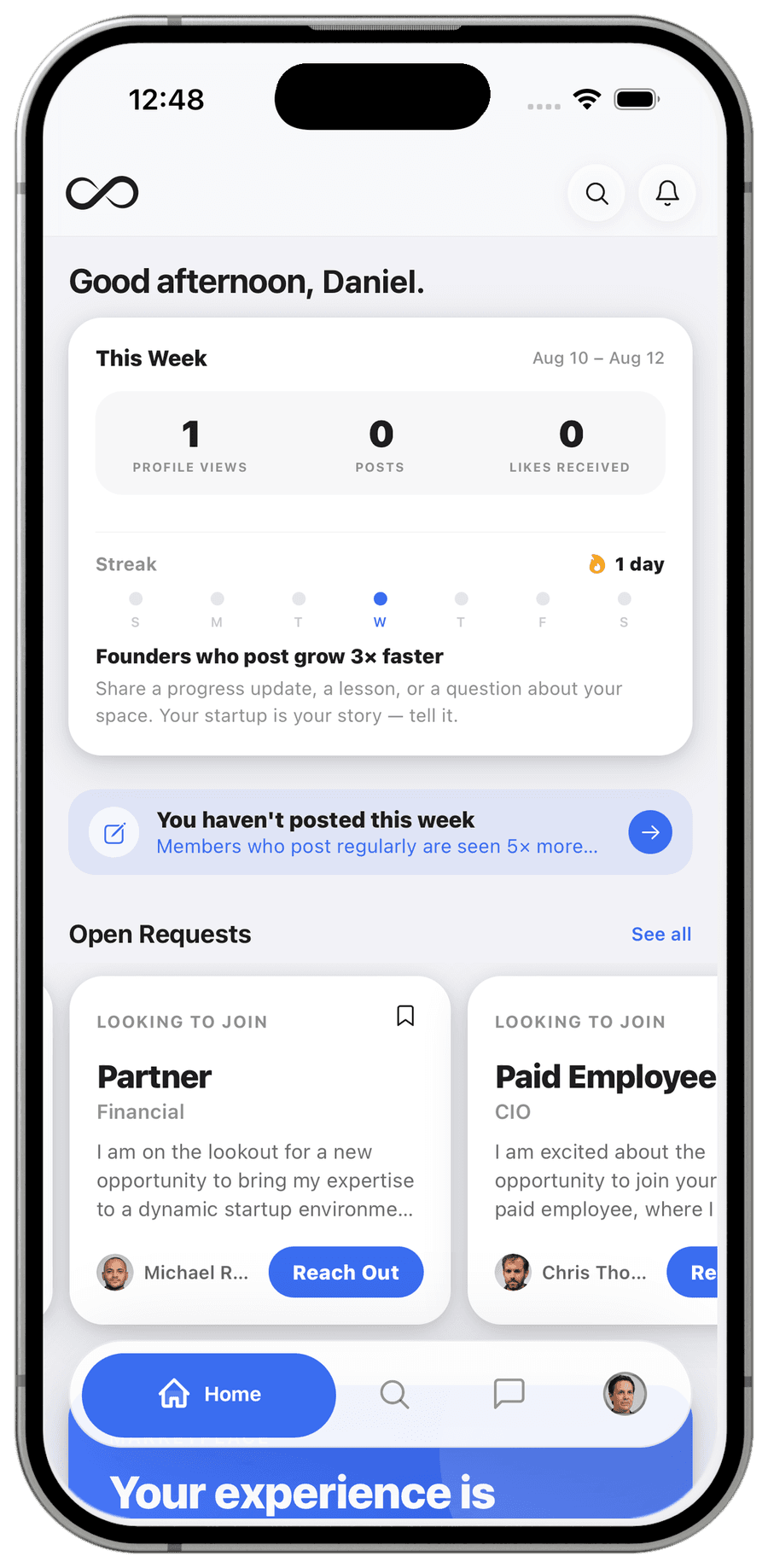
A first hire is a people problem before it is a process problem, and that is what we built Solution for: founders, developers, designers and operators in one place, where every conversation can start with a reason. It fits this guide well because people on Solution say what they offer, what they are looking for and whether they are open for work, so you are not messaging people who never wanted to hear from a startup. Your request does not get buried in an endless feed, and the replies come to you in one place. Here is how to use it with the template above:
- Build your startup page for free: what the startup does, its stage, what it is raising and the roles it needs. A good candidate wants to see this before a first call.
- Post a request for the role as a Paid role, or as a Junior role for an early-career hire. Pick the role (Developer, Design, Marketing, Product Manager and more), say what you offer and where you are, and paste the outcomes from your role description. Replies come to you in one place.
- Search for people by what they help with, what they are looking for, field and location, and check who is open for work.
- Turn on Smart Connections: answer a short four-tap questionnaire and get suggested people, each with the reason they fit (what you need, how you work and where you are). Your first message can then start with that reason instead of a cold pitch.
- Run everyone who answers through the same short process from section 05.
- What is free and what needs Membership: a profile, exploring the network, following people and startups, a startup page and your first three messages are free, and you can see that Smart Connections has picked people for you. Membership lets you message anyone directly, see who those picks are and why each one fits, post and answer requests, and use the Investor Desk, appear in the directory, join events and share posts and articles.
Sources: Solution ↗
Questions founders ask
When should a startup make its first hire?
When a recurring, important job takes more time than the founders can give it, you can describe what success looks like in 90 days, and you can pay the salary for about a year from cash you already have. Before that, contractors and part-time help are usually the cheaper way to learn.
Should my first hire be an engineer or a salesperson?
Hire for the bottleneck you can name. If customers are waiting for a product you cannot build fast enough, an engineer. If the product works and founders cannot keep up with demand, sales. If you cannot name the bottleneck, keep doing the work yourself a little longer.
How much equity should a first employee get?
There is no single right number; it depends on salary, stage, role and how much risk the person takes. Whatever you offer, put the number of shares or options, the vesting schedule and the cliff in writing, and have a lawyer prepare the grant.
Is a paid trial task fair to ask for?
A short task that looks like the real work is fair and often more useful than extra interviews. Keep it small, tell candidates how long it should take, and pay for anything longer than an hour or two.
Written by Solution editorial. Platform descriptions were checked against the sources below. The worksheet and examples are our editorial framework, not research findings or promises of results. Solution publishes this guide and offers its own startup networking app.
- IRS — Independent contractor (self-employed) or employee? ↗ · Checked 2026-10-31
- Y Combinator Startup School — The Startup Playbook for Hiring Your First Engineers and AEs ↗ · Checked 2026-10-31
- Carta — Vesting: a guide to schedules, cliffs, and acceleration ↗ · Checked 2026-10-31
- Solution ↗ · Checked 2026-10-31
Found an error? Tell us so we can correct it.
Put the guide into practice.
Start a new connection.
Find Solution on the App Store and Google Play.