Ask one relevant contact whether they are comfortable checking an investor’s interest. Explain why the investor fits, provide a short note they can forward, and let both people opt in before connecting them. If no credible introduction is available, check whether the investor welcomes a direct approach instead.
01. Give the introduction a specific purpose.
A warm investor introduction happens when someone who knows you connects you with an investor they know. The connector supplies context that a message from a stranger may lack. Their relationship does not establish investor interest, and an introduction is not an investment commitment. Treat the first exchange as an opportunity to find out whether a conversation would be useful.
Before asking for help, write a fit sentence: “This investor could be relevant because their stated focus includes our stage, sector and market.” Check the investor’s own website and current team information. A familiar logo or a funding announcement from years ago is a lead for research, not a complete explanation of fit. OpenVC’s filtering documentation distinguishes stage, geography and investment-size criteria; use those as questions to verify, not as proof of willingness to invest.
Identify a connector who actually knows the person and has enough context on your work to decide whether to help. A shared connection on a platform does not tell you how well two people know each other. If you are uncertain, ask whether they know the investor well enough to consider an introduction before asking them to endorse your company.
- Name the investor or relevant partner and record why that person fits.
- Separate what you have verified from what you still need to ask.
- Describe the conversation you want: feedback, an introduction or a discussion about a possible round.
Sources: OpenVC: Filter the right investors ↗
02. Send the connector a small, answerable request.
Your first message has one job: help the connector decide whether they are comfortable checking interest. Give them a concise update and a clear reason for this particular investor. Avoid sending a long list of names that leaves the research, prioritization and writing to someone else. A focused request is also easier for you to follow up on accurately.
Keep the request separate from the note intended for the investor. The connector may want different wording, more context or no involvement. Give them that choice. Do not write endorsements in their voice or imply that they have personally verified claims they have only heard from you. Replace the placeholders below with facts you can substantiate; remove any line that does not apply.
Subject: Could you check interest in an introduction to [investor]?

Hi [connector],

We’re building [product] for [specific customer]. Since we last spoke, [one factual update you can support].

I’m researching [investor] because [specific, current reason for fit]. Do you know them well enough to feel comfortable checking whether they would welcome an introduction?

I’ve included a short note below that you can forward if helpful. Please change it, ask for more context or decline if it does not fit your relationship.

Thanks,
[name]
Replace the placeholders with accurate details before sending.
Your network is part
of what you’re building.
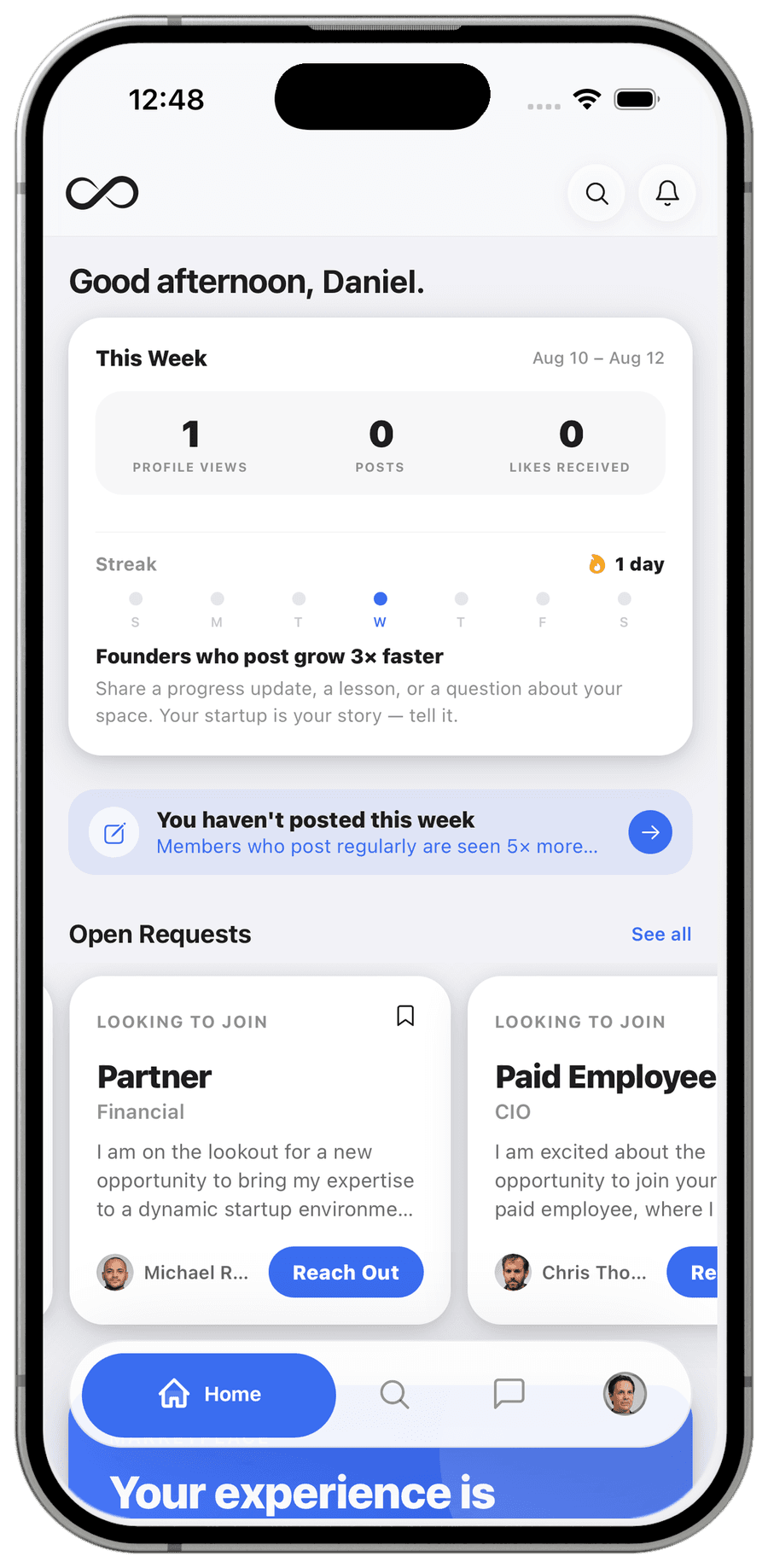
Solution is a social network for founders, investors, mentors and the wider startup ecosystem. Explore the app to see whether it fits your next step.
03. Write a note that makes sense when forwarded.
The investor should be able to understand the message without reading a separate thread. State what the company does, for whom, one relevant piece of evidence and why you are approaching this person. Use a public website or an overview you are comfortable sharing. A private customer list or unrestricted data-room link is unnecessary for a connector to check initial interest.
Michael Seibel’s advice on emailing early-stage investors emphasizes a clear explanation and an explicit request. That supports a concise note, not a universal rule about an exact word count or the best meeting length. In the template below, the request is permission to continue the conversation. It does not assume that the investor wants a call or that the connector has already made an endorsement.
If you are still testing an idea, say what you have actually learned instead of stretching it into traction. A conversation with a potential customer is not revenue. A pilot is not automatically a paying deployment. Specific, limited evidence makes a more credible starting point than an impressive sentence you cannot explain when asked.
Subject: [Company] — [specific customer problem]

Hi [investor],

I’m [name], founder of [company]. We help [specific customer] do [specific job] through [plain-language explanation].

Our current evidence is [one accurate signal, with a period or context if needed]. We’re exploring [your actual next step].

Your work on [verified focus or relevant experience] led me to think there may be a fit. Would you be open to a short overview to decide whether a conversation makes sense?

[public website or shareable overview]

[name]
Replace the placeholders with accurate details before sending.
Sources: Michael Seibel: How to Email Early Stage Investors ↗
04. Let both sides choose the introduction.
A double opt-in introduction means checking that both people want to be connected before putting them in a shared thread. Investor Fred Wilson describes this as his preferred introduction etiquette. It is a useful practice to discuss with your connector, rather than a claim that every investor follows the same process.
After sending the request, let your connector check interest. Do not add the investor to the thread yourself or share private contact details on the assumption that a connection is welcome. If the connector says they do not know the investor well enough, accept that answer. You can ask whether they suggest an appropriate public route, but avoid turning a declined introduction into a repeated obligation.
When an introduction arrives, thank the connector, acknowledge what the investor has agreed to and take the next step within that scope. If they agreed to read an overview, send the overview. If they agreed to discuss your company, propose a practical way to arrange that discussion. Avoid expanding a small initial exchange into a request for a whole set of services.
Hi [investor],

Thank you for being open to the connection, and thank you [connector] for introducing us.

As promised, here is [the overview or context they agreed to receive]. The question I’m hoping to explore is [specific question].

Would [a bounded next step consistent with their reply] be useful?

Best,
[name]
Replace the placeholders with accurate details before sending.
05. Use a decision checklist when the path is unclear.
Imagine a founder with a working product who knows a mentor connected to a relevant investor. This is an illustrative scenario, not a Solution customer story. The founder can explain the product and has checked the investor’s focus, but does not know how close the mentor is to the investor. The next action is a relationship check, not a message claiming the mentor has recommended the company.
If the mentor confirms a relationship and offers to check interest, the founder sends the forwardable note. If the investor declines, the process stops. If the mentor cannot help, the founder checks the investor’s published contact preferences. Each outcome leads to a clear next action without inventing an endorsement or treating silence as consent.
Use the questions below before moving to a shared thread. They are an editorial checklist for keeping the process clear, not a scoring model or a predictor of fundraising success. If an answer is missing, resolve that question rather than compensating with more email volume.
- Fit: can I explain why this investor is relevant using current evidence?
- Relationship: does my connector know the investor well enough to decide whether to help?
- Accuracy: could I explain and support every claim in the note?
- Permission: has the investor agreed to this connection or next step?
- Scope: am I sharing only the information needed at this stage?
- Next action: do I know whether to wait, send context, use a public channel or stop?
06. Follow up with something useful, then close the loop.
If you have not heard back, consider the person’s stated availability and the context of the request before following up. There is no universal interval that fits every relationship. One concise check-in can clarify whether the request is still useful. Repeated automated reminders do not create permission to use someone’s relationship.
Add a meaningful update only if it is true. Otherwise, acknowledge that timing or fit may have changed. If the connector or investor declines, respect the decision. If a conversation happens, thank the connector and share a brief update if they welcome one. Keep confidential details out of that update unless you have permission to share them.
A warm introduction is one possible route, not a condition you must satisfy before ever contacting an investor. Seibel explicitly cautions against spending excessive time obtaining introductions and describes a direct email approach. Where an investor publishes a submission route, follow that route. A careful direct message can be more appropriate than asking a distant contact to imply a relationship that does not exist.
Hi [connector],

A quick check on my earlier request about [investor]. [One relevant factual update, if there is one.]

If checking interest is still comfortable for you, I’m happy to send any missing context. If the timing or fit is wrong, I’ll leave it here.

Thank you,
[name]
Replace the placeholders with accurate details before sending.
Sources: Michael Seibel: How to Email Early Stage Investors ↗
07. Make your next connection specific.
Solution is a social network for the startup ecosystem, including founders, investors and mentors. If you are exploring people in that ecosystem, use a profile and a clear explanation of what you are building to give a potential conversation some context. A connection in an app does not by itself establish willingness to introduce you, invest in you or endorse your claims.
Start with one relevant person and an honest reason to talk. Choose the appropriate template from this guide, replace the placeholders and check the permissions before sharing. Solution publishes these resources and offers its own app; exploring or downloading it does not guarantee access to investors or an investment outcome.
Sources: Solution: The Hub For Startups ↗
Questions founders ask
Do I need a warm introduction to contact an investor?
No universal requirement applies. Check the investor’s current public contact preferences. A relevant introduction can supply context, but a concise direct approach may be appropriate when no credible introduction exists. Do not spend indefinitely chasing a weak connection.
What should I put in a forwardable investor email?
Explain the company in plain language, name the customer, give one accurate signal of progress, explain the investor fit and ask for a bounded next step. Include a link you are comfortable sharing. Avoid writing an endorsement on the connector’s behalf.
What if my startup has no revenue yet?
Describe the current stage and evidence accurately: a prototype, specific learning or another relevant fact. Do not label conversations or intentions as paying traction. Remove a traction line if it would mislead the reader.
How should I handle a declined introduction?
Thank the person and respect the decision. You may ask whether they suggest an appropriate public channel if that fits the conversation, but do not add the investor to a thread or repeatedly pressure the connector.
Written by Solution editorial. Platform descriptions were checked against the sources below. The worksheet and examples are our editorial framework, not research findings or promises of results. Solution publishes this guide and offers its own startup networking app.
- OpenVC: Filter the right investors ↗ · Checked 2026-10-23
- Michael Seibel: How to Email Early Stage Investors ↗ · Checked 2026-10-23
- Fred Wilson: The Double Opt-In Introduction ↗ · Checked 2026-10-23
- Solution: The Hub For Startups ↗ · Checked 2026-10-23
Found an error? Tell us so we can correct it.
Put the guide into practice.
Start a new connection.
Find Solution on the App Store and Google Play.